

Unit 4 is quite a tricky wee paper due to the demands placed on pupils to partake in ‘task switching’ (great read if you are interested in knowing more). The shifting of approaches from Personal/Creative Writing to the Literary Comparative question can be daunting for many. I have found this to be particularly prevalent when working with C/D boundary and/or SEND pupils, so it is always important to build in lots of practice and use ‘hacks’, so that they can come armed and prepared for their exam. It also gives them a sense of control and some surety.
Rapidly shifting between questions can lead to other difficulties like time loss and decreased accuracy. The brain needs time to re-adjust and recalibrate when switching between tasks, resulting in a “switch cost” that can impact performance. Then there is the cognitive load and tail off associated with the two heavy writing tasks at the beginning. I was able to see this using CCEA Analytics QLA (Question Level Analysis), that showed a drop in marks as some pupils worked through the exam. I would recommend using the CCEA programme, especially in a mixed-ability setting. (Want to know more? Feel free to email for a walkthrough.)
In this blog, I will be sharing some of these highly successful approaches. Some might say that these approaches appear to be a little scientific or too rigid; however, having used them across a range of abilities, I have seen how pupils adapt and shape the strategies to suit themselves, and there is certainly learning in that too!
Unit 4: Task 1 – Personal or Creative Writing
Tips for Task 1 – again, these are some tried and tested methods:
- Include 5Ws and How…? for planning your essay – this can be a backup too
- Focus on a moment or zoom in and slow down the writing (Creative and Personal)
- Memorise some structural sentence stems as shown on the KO
- Create a recall grid and include positive and negative emotive language (see below)
- Practise using one-line paragraphs for effect – use non-fiction articles as examples
- Preload ideas for person, place, memory or object – find overlaps!
- Demystify and explicitly link the reading and writing tasks, and the importance of knowing how to identify, explain (reading) and effectively include language devices (writing).
Recall grid example: Pupils scribble these points down on the planning page or a spare sheet at the start of their exam. I do this in A3 format too, and then we hold them up to see how much they have remembered—low stakes, high impact!
I would get the class or pupils to select parts of the KO to be put into each box. They will then revise and learn these pieces of information, and then take part in a ‘Brain Dump’ exercise. This is useful for two reasons: it can reduce exam anxiety, and it means pupils have, to some extent, internalised a writing frame that they own and are able to use. It doesn’t work for all, but it might work for some—especially those who are sceptical about English and revision!


Unit 4: Task 2 – Literary Comparatives
This section really depends on your cohort and context, so I will show how I have done this in the past and perhaps it will give you some ideas. I created the ‘NOCSSE’ approach which you can find in my shop – again, this is just some mental velcro for pupils to use. This is also embedded into the KO (below) and is another way for pupils to have control and prepare for some of the challenges included in the literary comparative.


Task 3 and Task 4 are a continuation of the previous paper and there are some useful mark scheme based stems and exercises that you can do with the KO. With plenty of cross over from Unit 1, these tasks can be more straight forward to revise and practise. This KO is split into thirds and is used in the same fashion as I described in my previous Unit 1 blog.
Bonus – Non Fiction Activities and Resources:
Below is a slide show with a brief lesson in a mixed ability setting. It involves the November 2024 Task 3 and Task 4. We did some visualiser work for Task 3 first of all with some whole class labelling and discussion. For Task 4, pupils used the KO to write their own labels (here – you can edit) and recurring points, and then we printed them, and gave them out to the class. They had to identify the best example for their points on their labels and stick them onto the article. If you have a Clevertouch board, this can be done digitally too. This is good for reinforcement and confidence, and changing the lesson up a bit. Afterwards, they would use the scaffold support (here), which has been highly successful for all abilities, to write their ‘good paragraphs’ and share with the class. This scaffold has generated rich discussion and encouraged pupils to read aloud.


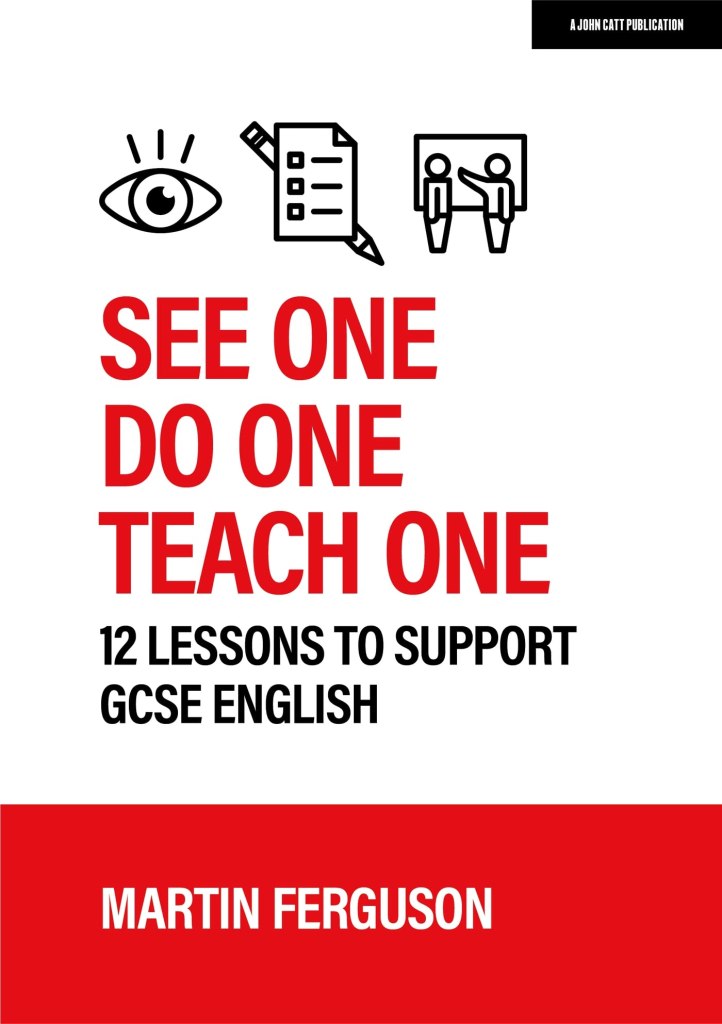
If you would like more scaffolds, models and exam hacks, you will find my book useful too – ‘See One Do One Teach One’ – thanks for reading and I hope you have found this blog helpful!

If you would like FREE A3 posters from parts of my book based on Persuasive Writing, Creative Writing and Literary Comparatives, you can find them on Jamie Clark’s website: https://www.jamieleeclark.com/graphics

Leave a Reply