

“If you have the words, there’s always a chance that you’ll find the way” is a quote by Heaney that underscores the transformative power of words in the classroom. It has always stuck with me when I first heard it during in the early stages of my career at a literacy presentation in Stormont by a primary teacher (update: credit to Tanya McCrory who kindly got in touch after reading). By focusing on language, vocabulary, and communication, we can unlock pupils’ potential and guide them towards incremental success, emphasizing ‘progress over perfection.’
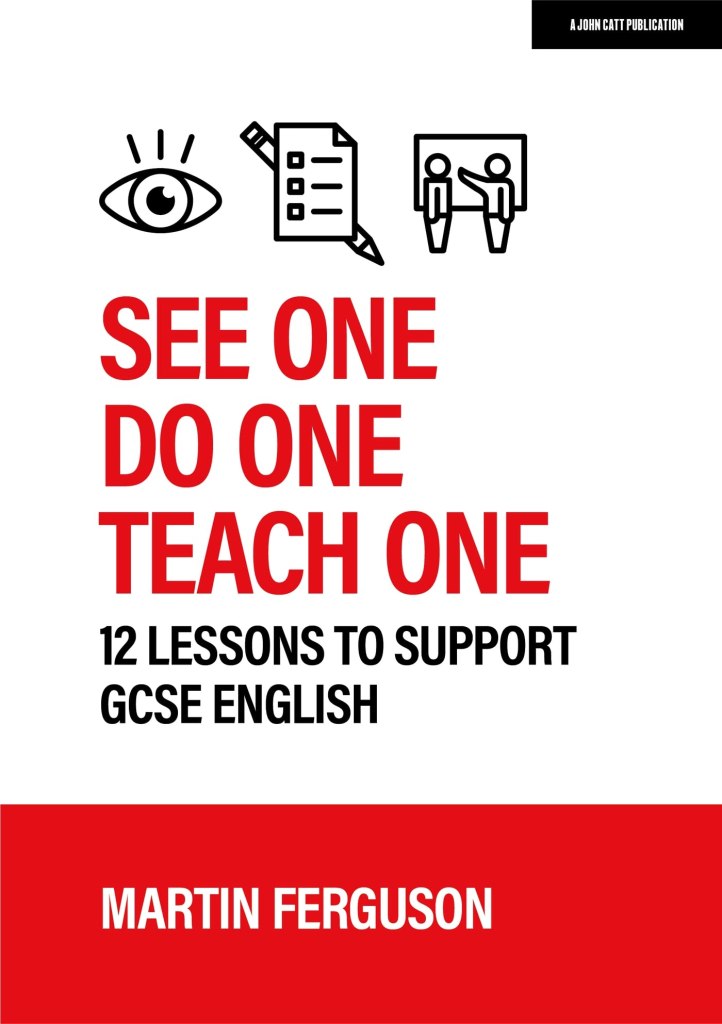
Carefully planning scaffolds, thought stems, and vocabulary is invaluable for shaping talk and discussions around a topic, task or extract, especially if this leads to writing it down. In my book, I incorporated this approach in the ‘Teach One’ section, where I created questions for pupils to ask one another when they have completed the task or to consolidate. I would argue that this is a largely underutilised element of formative assessment and that opportunities can be missed or lost because, as teachers, we have a natural preoccupation with putting pen to paper as soon as possible.
Thinking, Talking and Doing:
The task for this lesson was to think of an interesting topic of choice, write a bit about it and then eventually deliver a short presentation. The pupil started by writing down some of her thoughts and ideas. She used the 5Ws and some prompts from an informal discussion, which resulted in some loose ideas on a page.
She has a chronological age of 15:00 and has missed a lot of school. Her spelling and reading age are around 10:00, but she is verbally quite confident. Naturally, apprehension and avoidance begin when I ask her to convert her thinking into some form of writing.
It was obvious that anything to do with animals or pets would help get the ball rolling. The presentation entitled “My House is a Zoo!” was then created by the pupil. This led to a further discussion around articles and speeches: What would we expect to read about in an article with this title? What tone would it be written in? Who would it be aimed at? Would it be funny, serious or a blend of both? Why? We discussed the metaphorical headline and how it could be extended in her writing and attempted to dig a little deeper.

Using Mini-Whiteboards for Drafting and Editing:
You can see where I have ticked the prompts I used and where she has highlighted parts of the A3 page below that she will attempt to use. Whilst there are some errors, she has included some alliterative phrases and there is evidence of an awareness of purpose and audience. The next stage was to begin writing this out. She requested a white board so she ‘could rub the mistakes and fix it for the page’.
The whiteboard offers a safe starting place and allows for softer self editing and correction. The ticked sentences are the ones we did verbally and she then decided to add to her original piece. Interestingly, I have found that some pupils have a preference for the A3 format and will ask for it. They describe it as being ‘more spaced out’ and ‘easier to read and make notes’.
The Visual-Spatial Attention and Reading:
There is some interesting research on reading and visual spatial attention that claims that children and adolescents with dyslexia are less able than their peers to select information and filter out irrelevant information. There is also an association between spatial attention deficits and developmental dyslexia – so again, testing and baselining are important here as they inform the very presentation of your resources or texts. Less is more and there should not be any unnecessary images or distractions.
(Some research here, here and here and EEF report on Dialogic Teaching)
Simplifying Text for Better Tracking:
In this resource, I tried to “step it down” so that tracking the text is easier. Studies show that efficient reading requires the ability to track text across a page. These challenges cause some pupils to lose their place or skip lines. Visual-spatial issues can make it challenging to follow lines of text, so you could convert this into a vertical structure strip. With this format, I can move down the page, and the stems are ordered to support an intro and first paragraph or anecdote. I get the pupil to select one or a few of them. Then, they write a sentence to go along with it, and we expand, connect, and build from word level, to sentences and then paragraphs.


Together, we began to shape the writing into coherent and ordered sentences. These were eventually formed into paragraphs. Using assistive technology and a thesaurus, she managed to improve her first two paragraphs and then read it aloud.
Oracy Opportunity: Engaging Classroom Discussions:
Put a topic on the board and get the class to write a few points in response or spider diagram ideas on whiteboards. On your board or Clevertouch (if you are lucky to have one), display the stems and ask them to finish them off. You can make this suit any topic – I have used football teams, movies and music to gain some verbal responses which can very entertaining – similar to the format of the headline round in HIGNFY. (obligatory content warning)
I would recommend reading Robin Alexander’s presentation on Improving Oracy in the Classroom where he discusses the cognitive benefits of talk or as I would refer to as, ‘rich talk’.
GCSE Writing for Analysis and Evaluation:
Below is an example that I would use as a staple for classroom discussion and framing thoughts and ideas. It is transformative when it is part of a routine. For example, placing a short extract (Lit or Non-Fiction) on the board, I would ask pupils to reflect on what they have read and write down some initial thoughts. We do it as a group and then we begin to gather and expand ideas and thoughts. I would then ask them to select one or two of the stems and try and shape their talk. Finally, we would write it using the frame below.


You can download the resources here:
Thank you for reading and I hope you found this useful. Feel free to comment, contribute or contact me for further information or resources. M
Leave a Reply